|
|
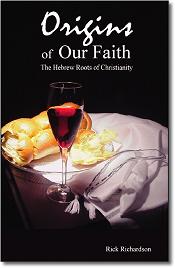
Click Here to Buy the Book
or Read it On-Line |
| Origins of Our Faith
is an historic look back to the
Hebrew roots of Christianity. Rick Richardson explains how and
why a small group of Jewish "believers" were transformed into
the most influential religious movement in history, and how
returning to the origins of our faith is the only way
to reach our destiny.
|
Warning:
This book may cause a paradigm
shift. It turns Christianity upside down and gives new
meaning to our faith, purpose and future by exploring
Christianity's Hebrew roots. |
|
|
___________________________________________

Could "Believing" in Jesus
PREVENT you from being "saved"?
Paul says:
Romans 10:9
If you shall confess with your mouth the
Lord Jesus, and shall
believe in your heart that
God has raised him from the dead, you shall be saved.
Most Christians would read this passage as saying: you must believe
that Jesus is God in order to be saved, and yet when asked what one
needs to do, to have eternal life what did he say?
Matthew 19:16
One came and said to him,
Good
Master, what good
thing shall I do, that I may have eternal life? And he said to him,
Why do you call me
good? [there is] none
good but one, [that is],
God: but if you will enter into life, keep the commandments.
Jesus does not put the focus on himself. There is no need to
believe that Jesus is God or even a Messiah. Rather, Jesus says
simply to keep the commandments, stressing also, that there was only
one that was good; and it was not him. Only God is good.
It is ironic that the one thing that many Christians believe will
save them is the one thing that is PREVENTING them from being saved;
believing that Jesus is God. Why would that be?
In the verse that we just read, Jesus says that the way to eternal
life was to keep the commandments. What then would be the most
important commandment to keep?
Mark 12:28
One of the scribes came, and having heard
them reasoning together, and perceiving that he had answered them
well, asked him, “Which is the first commandment of all?” And Jesus
answered him, “The first of all the commandments [is], Hear, O
Israel; The Lord our God is one Lord: And you shall love the Lord
your God with all your heart, and with all your soul, and with all
your mind, and with all thy strength: this [is] the first
commandment. And the second [is] like, this, you shall love your
neighbor as yourself. There are no other commandments greater than
these.” And the scribe said to him, “Well, Master, you have said
the truth: for there is one God; and there is no other but he: And
to love him with all the heart, and with all the understanding, and
with all the soul, and with all the strength, and to love [his]
neighbor as himself, is more than all whole burnt offerings and
sacrifices.”
So the
belief in One God is the greatest commandment, as Jesus said and was
confirmed by the scribe. And although Jesus believed he was
certainly inspired by God, to claim that he WAS God would violate
this (the first or greatest) commandment. Since Jesus said
that keeping the commandments was the way to eternal life, from a
Jewish perspective, to believe that he was God would be the worst
thing that you could do.
For the
Greeks, however, this was not so. They had a god for
EVERYTHING. To believe that Jesus was NOT God would be un-natural
for them. So as the beliefs developed among the early Greek
(Gentile) Christians, they struggled to comprehend the Hebrew
(Jewish) concept of Messiah. But their understanding of what
Messiah was, was quite different than the Hebraic (Jewish)
understanding.
So if the
Jewish understanding of Messiah is NOT God coming to the earth as a
man in order to save mankind, what was Messiah to do, and how then
are we "saved"?
Continuing
with the verse above:
Mark 12:34
And when Jesus saw that he answered discreetly, he
said to him, “You are not far from the kingdom
of God”.
The kingdom of God was the message that Jesus preached. It is what
he called the “good news” or the gospel. This was the message that
Jesus "sent" to deliver.
Luke 4:43
And he said to them, I must preach the
kingdom of
God
to other cities also: for therefore am I sent.
What exactly is the kingdom
of God? It is that time in the future when the lost northern
kingdom of Israel is reunited with the saved southern kingdom
of Judah, and Messiah will rule over both of them during an era of
peace.
Jeremiah 31:31
Behold, the days come, says the LORD, that
I will make a new covenant with the house of Israel, and with the
house of Judah: Not according to the covenant that I made with their
fathers in the day [that] I took them by the hand to bring them out
of the land of Egypt; which my covenant they broke, although I was
an husband to them, says the LORD: But this [shall be] the covenant
that I will make with the house of Israel; After those days, says
the LORD, I will put my law in their inward parts, and write it in
their hearts; and will be their God, and they shall be my people.
The key prophecy to be fulfilled in order for this to happen is the
RETURN of the northern kingdom.
The Hebrew word for "repent" is tshuvah and is better
translated as "return". So when Jesus was saying, “Repent for
the kingdom of God is at hand”, he is saying “return”.
Who is he expecting to return?
Jesus
believed that he was the Messiah that dies. In Jewish
tradition that Messiah is called Messiah ben Joseph. The task
that Messiah ben Joseph was to accomplish, was (through his death)
the return of the northern kingdom. This is how the northern kingdom
is "saved"; they are brought back from exile, and are no longer
"lost" among the nations.
Jesus said that he came to “save that which was lost” in Matthew
18:11, and in Matthew 15:24 he says that he was ONLY sent
to "the lost sheep of the House of Israel".
The phrase
"the lost sheep of the House of Israel" is not an ambiguous one.
The prophets talk about the "House of Israel" and the "House of
Judah". The House of Israel (the northern kingdom) is also referred
to as people that are lost. So to say "the lost sheep of the House
of Israel" is very specific. It refers to the northern
kingdom, sometimes called the Lost Ten Tribes.
The
northern kingdom was a nation of rebellious people who did not
follow God nor keep his commandments. The main sin of the nation was
idolatry (following other gods). By making Messiah into God,
many people, who believe that today they are part of the northern
kingdom, are guilty of precisely the same sin as their forefathers;
the sin of idolatry.
It is
the biggest obstacle preventing the northern kingdom from returning.
The task of abandoning the Greek version of Messiah is not easy;
there is much in Christian theology that hinges on the belief that
Messiah is God. There seems to be much more UN-learning to do
before the northern kingdom is truly "saved".
Rick Richardson
Click Here
to Make Your Comments
Comment:
i think that its the truth but i think that JESUS
and FATHER are one the same WORD of GOD become flesh
JESUS is LIGHT of this WORLD ALL IS MADE TRU HIM
name: alen
city: Sisak Croatia
Alen,
Yes, this has been the Christian belief from the earliest Greek
"church fathers".  However, It was NOT (nor ever has been)
the Jewish belief.   Since the first followers of Yeshua (Jesus)
were all Jewish, they did not believe that he was God.
For a more complete view of this subject, read my book
(it's FREE on line).  Just click on the book cover on my homepage.
Rick Richardson
A Bunch of Jewish Guys
(posted 02/01/08)
I often say that
"Christianity began as a bunch of Jewish guys". This is one of the
most important concepts for people to get their mind around.
And yet, even for people in the "Hebrew Roots" movement they have
difficulty seeing the New Testament through "Jewish" eyes.
Remember, the
Greeks that Paul went to, the ones who later became leaders of "the
way" (after the Hebraic leadership had all been killed) were not
Torah scholars. They were Greeks. They knew Greek philosophy
and mythology, and understood, transcribed and paraphrased in that
context.
God's intention was
to bring back the northern kingdom at a distant time in the future.
They were not to understand, and indeed DID NOT understand. It was
not the time.
The Christmas Tree
and the Easter Bunny are part of THAT Greek (pagan) culture, as was
the concept of God having a child through a human being that would
then "save" humanity.
When the Jews talked
about a Messiah that would "save" the Lost Tribes of Israel and
reunite them with the House of Judah, the Greeks understood that in
a very Greek way. They mixed in their own traditions and eventually
arrived at an entirely different place of understanding.
It is a difficult
thing to do, but we must look at Christianity as a first century
Jew, rather than a 21st century Christian, if we are ever to
understand the original message.
Rabbi Michael
Skobac from Toronto gave a talk about Christianity. I have
tried to piece it together here.
Rick Richardson
Click Here
to Make Your Comments
Dividing the land of
Israel
(posted 01/20/08)
I keep asking
myself ... Can they REALLY be serious? I honestly do not
understand how people that I believe possess a certain level of
intelligence can be so foolish. The "Roadmap for Peace" being
proposed by President George W. Bush, the UN, and others, is in
reality a "Roadmap for Disaster".
It certainly would
be helpful IF there had EVER been ANY history where giving up parts
of the Jewish homeland has resulted in a more peaceful situation.
Actually just the opposite is true. The
EXPANSION of the Jewish homeland HAS resulted in more peaceful
conditions.
Israel PROTECTS the
holy sites of ALL faiths. This has not been the case whenever
control of those sites are relinquished to the P.A. Israel
develops the highways and industry. To this point in time the
Palestinian people have been far better off under Israeli rule than
under their own rule. It would be nice to see ANY evidence of
success by the P.A. before giving them more territory to destroy.
The clear examples
of Bethlehem, Jericho and Hebron and most recently the evacuation of
Gaza leave little question as to how to secure peace and protection
in the region.
I support
the Israel Initiative is a plan
to annex the West Bank and Gaza into the land of Israel. It
provides for the resettlement of those who would not desire to
remain under Jewish rule, and creates the opportunity for those who
would pledge allegiance to the state of Israel to become full
citizens. Fairness and Opportunity seem to be a much better
"roadmap" for peace than political correctness and expedience.
While President
Bush was in Israel he was given a scroll that was prepared by the
New Jewish Congress, The Sanhedrin and the Temple Institute.
Rabbi Chaim Richman (spokesman for these organizations) reads the
contents of the scroll.
Mr.
President, let's focus on eliminating terrorist strongholds rather
than creating new ones. If you are really looking for peace in the
region, give Israel MORE land and resources. Allow Israel to fulfill
her destiny as a light to the nations. Peace CAN come to the
Middle East, but let us not ignore history and logic when we search
for it. It is closer than you can imagine. May it happen in
our lifetime.
Rick Richardson
Click Here
to Make Your Comments
What If ...
So let’s play a
game of “what if”. What if the northern kingdom of Israel, the
nation taken captive by the Assyrians around 722 BCE, is still
waiting to be redeemed. What if they did not return (in any massive
way) through gradual assimilation, and the return will be as the
prophets seem to write about in the Tanach: at the end of the age
the house of Israel will return from being lost among the Gentiles.
They will be drawn back from the four corners of the earth to the
true worship of God and to the land of Israel.
As the prophet
Ezekiel writes, the house of Israel is like a valley of dry bones.
It seems to appear out of nowhere. If the house of Israel (the Lost
Ten Tribes) is to come back to the land of Israel and be reunited
with the house of Judah, exactly how will it come about? How do you
know who a member of the lost tribes is? There are no identifying
marks. There is no defined history (after all they were “lost”).
The whole idea of a
completely “lost” nation, appearing out of nowhere at the end of the
age, sounds so unlikely it is easy to dismiss it all as a silly
legend. But “What if” … What if it really is to happen that way.
What would it look like? What if God began to bring the northern
kingdom back from exile, and there was no one to guide them or to
assist them along the way.
We know that IF God
has purposed a thing to happen it will happen with or without any
assistance from us. Yet, it would seem that being prepared for a
“what if” is not a bad idea. Even if there is no returning northern
kingdom, to ask the question “what if the northern kingdom returned”
is not altogether a worthless exercise. There are many people on a
pathway that leads them to a different vantage point of
understanding.
Several years ago
I met a gentleman in an ultra orthodox area of Jerusalem. He was
introduced to me as a rabbi of rabbis. I began my conversation by
saying “If there are a growing number of people around the world
(especially in Christianity) who are moving toward Judaism …” The
rabbi stopped me and said “Let’s not say “if”, we know it is
happening”. I paused (a little surprised) and then continued,
“Could this be the returning northern kingdom? And if it is, what
pathway is there for them to follow”?
People from all
around the globe are coming to Israel looking for answers. They are
asking for guidance and direction. If the orthodox community does
not take the roll of guide, there will be others who will. There
are any number of willing “leaders” with fringe (and sometimes even
dangerous) ideas who are more than happy to gather a following.
So what is the harm
in asking “What if”? What if the northern kingdom is now really in
a process of return? IF someone is asking for guidance … no, … if
many someones are asking for guidance, what is the harm in providing
that guidance? Do we need to PROVE that a person is from the
northern kingdom, before we say, “IF you ARE from the northern
kingdom, and are returning to God, here is the path.
Many of us come
with no agenda. We make no demands. We simply ask humbly for
guidance saying “let us go with you, because we have heard that God
is with you.”
We have no proof as
to a “lost heritage,” we have only a burning desire to “return” … to
return to a place that feels more like home than any place we have
ever been. We have nothing else to offer to take away your
suspicions and doubts.
Sometimes, however,
we must act on faith, believing that there is a right course of
action regardless of our understanding of all the facts. In the
book of Esther, Mordechai tells Esther “ if you altogether hold your
peace at this time, then will relief arise from another place”. But
who knows whether you have come to this place “for such a time as
this”.
To address the idea
of the northern kingdom’s return may be a controversial topic.
There may not be consensus. There certainly is no proof that we can
offer. It may well be that the best thing we could possibly ask
ourselves is … “what if”.
Rick Richardson
Click Here
to Make Your Comments
The One True Religion
What is the one
true Religion? Judaism, of course. Why on earth would I say such
a thing, and if I truly believe that, why am I not ant-Christian …
and why don’t I immediately convert to Judaism?
I believe that
Christianity is part of God’s great plan for the
redemption of all mankind, however, it is only a vehicle … a vehicle
to bring the northern lost kingdom of Israel back to the true
religion of Judaism. Christianity (in itself) is NOT God’s true
religion.
Those of us who
come from the Christian side of life, have been looking through a
set of lenses that have made everything appear “upside down”. We
have read through the Bible, picking through a buffet of passages
that seem to support our position. Like a conspiracy theorist (who
only sees what he chooses to see) and reads past all of those
passages that do not support his theory.
The Bible simply
does not support the main tenants of Christianity. Christianity is
a mix of paganism and Greek thinking with a dash of Messiah thrown
in the middle (to give us enough information to find our way back
when the time is right). Those who claim to be from the “Lost Ten
Tribes” of Israel, and at the same time believe that they (the
northern kingdom) come back to teach the Jews (the southern
kingdom), are simply reading past what they choose NOT to see.
As good as it my
feel to imagine ourselves as the hero that come and saves the day,
we are not the one with the answers. We are not the faithful son.
We are the prodigal son that abandoned our father’s ways. The
prophets do not talk of the northern kingdom returning and all the
Jews grabbing the corner of their garments to learn more about God.
For those in the
“Messianic Community” who believe that the Jews will (someday off in
the future) accept Jesus as God, are like those who “try out” for
the TV show “American Idol” with the dissolution that they can
actually carry a tune.
Yet, the process
that the northern kingdom must go through, is not simply changing an
attitude of belief … and then BAM we are now part of Israel. It is
a literal change of nationality. We BECOME a people. We learn and
grow, and go through a process. That process has been determined by
God from the beginning of Israel’s existence as a nation.
Today we call that
process conversion.
Many “Messianic
Jews” claim that they are now completed Jews because they have
accepted Jesus and have converted to Christianity. In reality just
the opposite would be true. If you are Jewish, go back to
synagogue. If you are a Christian, the ONLY way to be a “completed”
Christian is to abandon pagan beliefs.
It would be
incorrect to believe that there is more than one true religion.
Again, let me restate my position. Judaism is the ONLY true
religion. There is not one religion for Jews and another for
Gentiles. There is no such thing as a Noachide “religion”, separate
from Judaism.
I invite you to read
my book “Origins of Our Faith” on line, and I look forward to your
comments.
Rick Richardson
Click Here
to Make Your Comments
Comment:
Rick, I read your book a few years ago
and think it is a great asset for Christians.
Concerning this blog post, I agree with you.
There is only one religion, however, that religion,
Judaism, does address non-Jews with the Noahide laws.
This isn't "separate" but the people
are not Jews, either.

Christianity likes to talk about "legalism."
What that really is is requiring of someone something
he is not obligated to do.  All Jews are obligated
to keep the Torah; keeps that Law is not "legalism."
All Noahides are obligated to keep the Seven Laws;
adding anything else would be legalism.  A Noahide
who keeps those laws is as righteous as the
High Priest.

Right now I think the world is in a situation in
which people are trying to find where they fit.
Unfortunately, Christianity has given "gentile"
a bad name, and people who have searched for the
Hebrew roots of their faith feel inferior. This
has caused people to search for a new way to "fit"
and that can lead to pretense.

The ultimate is to seek His Truth and to live our
individual purpose in the world--in complete honesty
before HaShem.

Kol hakavod on your book,
name: Miriam
city: Colorado USA
Miriam,
Thanks for your thoughtful comments. You
are correct,
the degree of righteousness that one has,
is not achieved
by virtue of the amount of laws he is required to
keep.
It is that question of where we "fit"
that is often the most
difficult one to resolve.
Rick Richardson
Comment:
Thank you for providing your book online.
I look forward to reading it.
name: Robin
city: Shelbyville TN USA
Robin,
Thanks for the note. I look forward to
your comments.
Rick Richardson
Comment:
Rick, I know Christianity is full
of pagan practice. All that aside, is Jesus/Yeshua
King of Kings and Lord of Lords?  He did raise
from the dead just as He said he would and His
disciples testify to this fact.  Plus, He changed
my life and set me free and I am eager for His
soon return; gathering in the exiles such as myself/
name: Robyn
city: Richardson, TX
Robyn, These are all the
questions that you need to spend time
thinking about.
Trust that God will lead you in your
understanding, and be patient
with yourself and others. Rick Richardson
You're Not Like Me!
What exactly should
we expect every one else to think and act like? Well, like us,
of course. Since we view life through a certain set of lenses,
our perception of reality and truth are subject to what we see
through them.
And since we all
believe that truth is universal, each of us our views the other as
"not quite getting it". Can we agree upon the fact that none of us
holds all the answers ... and that we are not all born with our
beliefs and perceptions fully evolved? If so it would seem to
me that the most prudent course of action is one of patience and
caution.
True, there is
always the need for caution and verification when preceding into any
uncharted waters, and yet if we never move ahead, if we insist upon
arguing on the shores, we will never make all the discoveries that
God has for us.
Not everyone is at
the same place along their path. Be kind to one another, and
always try to make many more friends than enemies. Even though
we may not always see exactly what another sees, our paths will
continue to cross one another and if we are gentle and kind and
patient with each other, our journey will be a good one.
Rick Richardson
Click Here
to Make Your Comments
Comment:
Hi Rick, you are so right on. No, I'm not like you,
and you are not like me. Clones we are not!! Seriously,
you always seem to be able to see right to the heart of the
matter and it gives me confidence to understand that I can
have different opinions and still be "ok" until I learn
otherwise or stick with my particular viewpoint. Let's
agree to never stop learning!! Thanks for your insight.
Sally
Klamath Falls, Or. USA
My Evil Twin
When I was young I
knew a set of identical twins. One of the twins was always
getting the other one into trouble because of a mistaken identity.
Many criminal trials have ended tragically over the years because of
a rush to accuse, when we believe we have the "real" criminal, only
to find later that it was a case of mistaken identity.
It seems that I
have an evil twin. Although I am sure that my "twin" is a very
fine and good man, we have the same name. This has created a
bit of confusion. As life would have it, there are a lot of
other people with the name "Rick Richardson", but one of these other
people is a very prolific writer of Christian books. He is not
me. My book is titled "Origins of Our Faith". I have not
read the "other Rick Richardson's" books, but from their description
I would say that our theological perspectives very quite a bit from
one another.
My apologies to the
other Rick Richardson for any confusion. I can imagine the
firestorm against him for my book that may have happened,
considering what has happened when people assumed that I had written
HIS books. He, from what I can tell, is a mainstream Christian
thinker who writes for a mainstream Christian reader.
I don't mind being
criticized and challenged for my beliefs. However, we should always
try to "have the right guy". I cannot explain why someone else
has written something. You will need to take it up with him.
But please don't. Like I said, I am sure he is a very fine and
good man. Leave him alone. Because, after all, he is not
me either.
Rick Richardson
Click Here
to Make Your Comments
Will the "Real" Noachide
please stand up (and raise your right hand)
Over the last few
days I have been trying to answer the slew of questions concerning
my actions about standing before the Sanhedrin to take a Noachide
oath. It seems that I have unknowingly done some tragic thing.
Some have accused me of not being a “real” Noachide.
They may be
correct. I belong to no organization or “club” of Noachides, nor
have I ever professed as such. I don’t know the secret Noachide
handshake, nor have I been given the passwords. Apparently I did
not fill out my application for membership, and foolishly considered
that this was more of a matter concerning my relationship with God
than it was being in the right group.
If we are ever
going to get past the silly and petty name calling, we must all
realize that what is happening is NOT ABOUT US. We are not the
important factor in what is happening around us. God is working out
HIS plan, and wherever that leads is fine by me.
Susan (my wonderful
wife) and I stood before the Sanhedrin to take the Noachide oath
after this past Sukkot (2006). There was no agenda or statement
that we were trying to make, other than as non-Jews we were willing
to submit to the authority of the court and commit ourselves to
follow whatever rules or laws God expected us to follow. I offered
to help in any way I could, but did not press the matter. When it
seemed as if no help was wanted, that was just fine. I don’t mind
NOT being in the center of things.
Committing
ourselves to the service of God, in whatever way each of us can,
should not be a controversial thing. I would hope that this would
be an area that we can come to some agreement on.
I realize that we
do not all see the world around us from the same perspective. I am
willing to admit that I may not be a member of the returning lost
tribes. My thesis on the subject may be way off base. BUT, if I am
right; if we are seeing the beginnings of God moving to bring the
northern kingdom home, we can either ride the wave or try to stand
in its way. But, how do we know for sure that God has anything to do
with ANY of this. We may all have to just wait and see what
happens next.
There is no leader
in this "movement" and we must not be too eager to point fingers and
stir up controversy. The tendency, however, is often to become very
critical of the position in life that we are from. The person most
against smoking is an ex-smoker. A person who has changed many of
his Christian beliefs often becomes very anti-Christian. We all must
be patient with one another, and realize that not everyone is at the
same place on this pathway.
Be kind and decent
and don’t get in the habit of making demands that everyone see
everything the way that you or I may see them. It would be nice if
we were born with our beliefs fully developed and evolved, but that
is not the case. This is a messy process, but if we all clean up our
acts just a little bit, maybe the mess will become a little easier
to work through.
Rick Richardson
Click Here
to Make Your Comments
Comment:
Please excuse all the questions but I'm a bit
confused by what I have read here.  In one post
it says---As Christians we feel as if we have
the answers to life that Jewish folks need---and
in another it says---Susan (my wonderful wife)
and I stood before the Sanhedrin to take the
Noachide oath after this past Sukkot (2006).
And yet the whole seems to be geared toward the
house of Yosef returnees.  I'd just like to know...
who or what are you exactly.
Debbie
Texas
Debbie,
I realize that all these terms are a bit confusing.
How
could I put myself in all three distinctively different groups?
The problem is the terms have meaning in the context
that they are
used, and meanings get attached to terms
that may not be wholly representative of that particular term.
From my youth I have considered myself in the
Returning
Northern Kingdom (Lost Ten Tribes) group. I believe
that God is working to bring the Northern
Kingdom home.
Many if not most all of that group are found
today within
Christianity. There is much for that group to
learn (or unlearn
as the case may be). So when I say "as
Christians", I am
talking to that broad group of people, many of
whom are
just beginning on their path and are only starting to be
attracted
to "Jewish things", that are moving towards Sabbath and
Holy
Days and the understanding of who they are (or may be).
For the longest time I resisted anything having to
do with
Noachides. I felt it would be a step backwards. Why,
would
I, if I felt I was a member of the northern kingdom, want to
be a Noachide? If I am trying to keep the Sabbath to the
best
possible way that I can; if I am eating Kosher; if I am
trying to
practice the family purity laws; if I am trying to do
all these
things that a Noachide are clearly not required to do,
why would I
want to be one?
It was not until a Rabbi friend of mine explained
that
everyone who follows God is a Noachide, even Jews.
The
Jewish people (which would also include members
of the Northern
Kingdom who return), however, also
have MORE laws to live their
lives by. So by taking an
oath saying that you will obey the
seven universal laws
in no way prevents you from observing the 613.
At this point in our (the Northern Kingdom's)
history,
we are NOT a people. Many of us do not even know
what
tribe we are from. We have a feeling, and not much
more.
There is no proof. Until we can come to a mutually
accepted starting
point, any reconciliation of the two
kingdoms will be unobtainable.
The Noachide pledge
does not put one into a specific group, but
rather a specific
CATEGORY of individuals who believe in; trust in;
and
pledge obedience to the God of Abraham, Isaac and Jacob.
Thanks for your question,
Rick Richardson
Comment:
Thank you very much.  That helps a bit,
but this brings up more questions, if I may....
I've been learning on another house of Yosef's site.
Do all the house of Yosef groups teach this same
statement of faith in Yeshua.  Nazarene Israel
recognizes the secrets of Scripture: That both the
Jews and the Christians are essentially Israelite
peoples; and that Scripture prophesies a
two-thousand-year-long division between the Jews
and the Christians, that is beginning to be
healed in our day. While recognizing that the
Jews are also Israelite peoples, and will be saved
one day (re: Zechariah 12:10), Nazarene Israel also
understands that belief on Yeshua as the Messiah,
the Son of the Living Elohim (G-d) is a precondition
to Salvation (Matthew 16:16).  Or do some demand
that NT belief in Yeshua be abandoned, i.e.
[John 1:1 In the beginning was the Word, and
the Word was with God, and the Word was God.
2 He was in the beginning with God.  3 All
things were made through Him, and without Him
nothing was made that was made. Hebrew 10;11
And every priest stands ministering daily and
offering repeatedly the same sacrifices, which
can never take away sins. 12 But this Man, after He
had offered one sacrifice for sins forever, sat
down at the right hand of God,....]
Debbie
Texas
Debbie,
Yes there are many "Hebrew Roots" websites with very
Greek ideas. The idea that the Northern kingdom is now
saved
and the southern kingdom "will be saved one day"
is backward.
According to scripture (Hosea 1:7 / John 4:22)
The Southern Kingdom
has been saved throughout history.
It is the Northern Kingdom
That has been lost and is in
need of saving. That is why they
are called the LOST Ten
Tribes. You will find no place in
scripture where the
Northern Kingdom returns to teach the Southern
Kingdom.
Rather, when the Northern Kingdom returns they are
TAUGHT
by the Southern Kingdom (Zech. 8:23).
When the Greeks who became followers of Yeshua
began
to outnumber the Jewish followers. The Greek ideas
and concepts also
began to grow. Greek society was filled
with gods. The
concept of messiah was foreign to them.
The only way that they could
possibly understand messiah
was to think of him as a God. At the end
of the first century
and into the second, this concept began to
become more
prominent.
For a more complete explanation, go to the "aleph"
link.
It is a link to my book that is available to read on
line.
It is surprising how turned around we have become as
to
think that we, the rebellious lost tribes, are the ones with
the
truth and understanding.
Thanks Again,
Rick
Comments:
Ok, I've read the ten chapters online and what
strikes me is that it appears to simply ignore
anything in the New Testament that contradicts
the stated opinion. Take my previous quote from
the Epistle of John for example:  "In the beginning
was the Word, and the Word was with God, and the
Word was God. 2 He was in the beginning with God.
3 All things were made through Him, and without
Him nothing was made that was made."

Clearly, the New Testament claims that Yeshua
co-existed with God and was the actual creator
of all that exists.  If you deny this, then the
New Testament cannot be accepted as scripture
and should be thrown out altogether.

I notice also that very little, if anything, is
taken from the writings of the Apostle Paul and
for good reason.  It certainly does nothing for
the case you are attempting to make. Quite the
opposite:

Galatians, ch 2:14 But when I saw that they
were not straightforward about the truth of the
gospel, I said to Peter before [them] all,
If you, being a Jew, live in the manner of
Gentiles and not as the Jews, why do you compel
Gentiles to live as Jews?

21 ... if righteousness [comes] through the law,
then Christ died in vain.
Galatians 3:24 Therefore the law was our tutor
[to bring us] to Christ, that we might be
justified by faith. 25 But after faith has come,
we are no longer under a tutor.

Galatians 4:22 For it is written that Abraham
had two sons: the one by a bondwoman, the other
by a freewoman. 23 But he [who was] of the
bondwoman was born according to the flesh, and
he of the freewoman through promise, 24 which
things are symbolic. For these are the two covenants:
the one from Mount Sinai which gives birth to
bondage, which is Hagar --  25 for this Hagar is
Mount Sinai in Arabia, and corresponds to Jerusalem
which now is, and is in bondage with her children --
26 but the Jerusalem above is free, which is the
mother of us all.  27 For it is written: Rejoice,
O barren, [You] who do not bear! Break forth and
shout, You who are not in labor! For the desolate
has many more children Than she who has a husband.
28 Now we, brethren, as Isaac [was,] are children
of promise.   29 But, as he who was born according
to the flesh then persecuted him [who was born]
according to the Spirit, even so [it is] now.
30 Nevertheless what does the Scripture say?
Cast out the bondwoman and her son, for the son
of the bondwoman shall not be heir with the son of
the freewoman. 31 So then, brethren, we are not
children of the bondwoman
but of the free.

I do appreciate your taking the time to answer
questions as it is my intent to understand this
"phenomenon," as you call it.  With no offense
intended, but in all honesty, it seems to me after
this initial investigation that this movement is
some kind of hybrid faith ---neither fully
Christian or fully Jewish.

I would like to ask further, if I may, whether
the rabbis who presided over the public oath you
took to be a Noahide knew about and understood
your beliefs regarding Yeshua and the New
Testament; that you are teaching these ideas to
others?  I've read from other sources that the
rabbis are becoming very amenable to softening
their stance against these issues. I'd be curious
to know if there is any truth to that.

I can't help thinking about the famous reprimand
to the Laodicean church found in Revelations,
ch 3:15 "I know your works, that you are neither
cold nor hot. I could wish you were cold or hot."

From my perspective, I wish that you were either
Christian or Jewish (including Noahide) and not
a mix of both.  Then again, maybe this is the
clearest proof yet for an Ephraimite connection,
as it says in Hosea, ch 4: 17 "Ephraim [is] joined
to idols, Let him alone."
Debbie
Texas
Debbie,
Part of the difficulty we have in understanding the
New
Testament is we read from our modern English Bibles and
we
expect to find the meaning of the original text perfectly
preserved.
If you were to look at a pre-King James version
of the New Testament
you will find a different take on the passage in John
|
1525
(TYNDALE)
"In the beginnynge was that worde, and that
worde was with God: and God was that worde.
The same was in the beginnynge with God. All
thinges were made by it, and without it, was
made nothinge, that made was. In it was
lyfe; And lyfe was the lyght of men ..." |
|
In this translation "the word" is not capitalized
and does not refer
to a person, rather it is the personification of
the word that God
spoke to bring everything into existence.
This is how the Hebraic
followers of Yeshua would have understood
this verse. The idea
of a pre-existent Jesus is a later
development in Christology.
The New Testament has value, in that it is a
collection of testimonies
and letters that help us understand what
the early followers were
experiencing. It is NOT, however,
law, and it should never be
confused as such. On the other
hand, "throwing it out altogether"
would be narrow sighted, and
leave many gaps in our understanding
of this period of time.
You are correct to see that Paul, as Peter says, is
not always clear
in his arguments. Add to that, the biased
perspective of the scribes
in the early church, who copied the
letters, changing them to add
"clarity". Many times while reading
letters from Paul I can see what
his original arguments were, based
upon the scriptures he his quoting
and the context in which he uses
them. Many of the early Greek
followers, however, were
unfamiliar with the Torah, not realizing
what he was quoting. That
being said, I don't believe that Paul always
understood the reality
of the situation. I am sure things turned out
much different than he
thought they would.
Paul's mission was not to the Lost Tribes, as was
the 12 Yeshua,
(Jesus) taught. His focus was on the Gentiles.
So, by telling them
(the Gentiles) it was unnecessary to observe the
law and become
circumcised was exactly correct. A gentile is
fine just observing
the seven Noachide commands. A Jewish
person, however,
must observe all 613 commands in the Torah.
Messiah ben Joseph
does not come to save the Jews OR the Gentiles.
Rather, he
comes ONLY for the Lost Sheep of the House of Israel (the
Lost
Tribes).
You are also correct to notice that this is a messy
process.
There are many along the path, in various stages,
making it
difficult to ascertain the truth. We have been looking at
our
faith from a certain perspective for so long and we have
invested so much effort into our beliefs that it is hard to let
them
go and see things from a different vantage point.
It is a process that causes everyone to take a
second look at
the way things are, and try to image how they will
be.
Although Christianity has been, throughout history, filled
with paganism and idolatry, everything is in God's control
and works
together for God's plan for mankind.
I have found most of the Rabbis that I have met to
be
kind and patient men. They are able to both teach and
listen. I admire them greatly, and I am pleased to have
them
as my friends. One of the Rabbis in the Biet Den
who administered
the Noachide oath also wrote one of
the endorsements on the back of
my book.
I must say that I really
have found much of what
you are saying to be quite on
target. Some material
you have clarified has even been
helpful to me
in my correspondence with several Christians
who
have demonstrated animosity towards Judaism...I
have
used some of your insights to give them perspective.
My effort is to explain the purpose of Christianity
from a Hebraic
viewpoint; to explain who Yeshua believed he was; and
to
explain why so many Christians are moving towards Judaism.
It would be nice if the process were quicker and easier,
but it is
what it is. Yes, the Northern Kingdom is still holding
onto
much of it's idolatry. Elijah said, "How long will you stay
between two opinions?" There will come a time when the
whole
heart of the nation of Israel turns toward God. I pray it
comes soon.
Thanks Again,
Rick Richardson
Comment:
Rick says:  In this translation [i.e.,
1525 Tyndale] "the word" is not capitalized and
does not refer to a person, rather it is the
personification of the word that God spoke to bring
everything into existence.

However, reading further down in the same
chapter of John, we can read: 1:14  And the Word
became flesh and dwelt among us, and we beheld
His glory, the glory as of the only begotten of
the Father, full of grace and truth.

Do you still want to tell me that this is not
referring to the person of Jesus Christ?

Next, Rick writes regarding my suggestion that
if the New Testament is not to be considered as
part of the Bible, it should not be considered at
all:  "...throwing it out altogether" would be
narrow sighted,...."  yet, isn't this exactly
what Judaism, the very Judaism that you have
irrevocably linked yourself to through the
rabbis, done for the last two thousand years?

Please bear with me. I'm still trying to
understand here. I did not say Paul's arguments
were unclear. They seem very clear to me.
But perhaps they seem so to you since you
did not address the points I raised.  Is it
possibly because you have no answer for them?
If so, then please be honest enough to say
so and don't just ignore them.

To paraphrase, Paul states that Peter had ceased
to live as a Jew. He was enjoying his newfound
freedom from the Law and was essentially
living like a gentile.  Wouldn't Yeshua's
right-hand man (Peter) know better than this if
it weren't to be?

Paul goes further and says the law was a tutor
to bring us to a certain realization after which
it is no longer necessary.  And then he goes even
further still and equates those who live under
bondage to the law from Sinai with being children
of the slave woman Hagar.  This is obviously talking
about the Jews here, not the gentiles.

I personally do not have a problem with you
choosing not to believe this, but I do have a
problem with those who want to make the New
Testament over into something it is not.  If
I followed your thinking and decided that these
statements of Paul were only inserted later
by the Catholic Church seeking to remake
Christianity into a non-Jewish movement,
I think I'd find it impossible to know just
what was and what wasn't inserted so long
after the events.  According to this line of
thought, the entire collection of writings
is called into question, making it completely
unreliable for teaching or instruction.

You say that you believe Christianity is part
of a Divine plan to bring back Ephraim.  Then
what of Islam which also has the same roots
as Christianity?  Many Jews feel that some of
the Ten Lost Tribes will be found in Afghanistan
and other Muslim countries.

Correct me if I am wrong, but the sense
I am getting of this, as I said before, is that
it is neither truly Christian nor truly Jewish.
I don't believe you would argue that point.
Now, the Jewish writings define two groups of
people, Jews and non-Jews and yet you have
defined three: Jews, Ephraimites and gentiles.
Is it your belief that Judaism is missing
something that Ephraim needs to restore to
it in order for it to be whole?  And that this
"something" is those things which Ephraim
feels it may have gained from it's sojourn
within Christianity?  Is this why the
Ephraimites don't just give up Christianity
altogether and simply embrace Judaism?

I would really like to know.  I really would
like to understand this. I hope you will continue
answering these questions.  Many thanks.
Debbie
Texas
Debbie,
Yes this passage is NOT referring to a pre-existent
Jesus.
It is referring to the word of God.
It is saying that God had
his plan from the beginning of time.
That this plan included
a Messiah, and God brought this plan into
reality. This plan
and concept of redemption was in God's mind and
words
from the beginning of time. All of creation is centered around
this plan, and there is nothing that is created that does not take
this into account. Again it is NOT referring to a pre-existent
being. This way of thinking is standard in Hebraic (Jewish)
thought, however it is not the Greek way of looking at things.
Peter says Paul is hard to understand. If you
believe he is "very
clear", I commend you for your discerning
abilities. However,
I do not believe he is clear at all, that is why
there was such
controversy over his statements. In the book of
Acts Paul goes
to the Temple to fulfill a Nazerite vow to PROVE
that he was
NOT telling Jews that they did not have to keep the law.
Your conclusion to:
But when I saw that they walked not
uprightly
according to the truth of the gospel, I said
unto
Peter before [them] all, If you, being a Jew, live
after the manner of Gentiles, and not as do the
Jews,
why compell you the Gentiles to live as do
the Jews?
Is to say:
Peter
had ceased to live as a Jew. He
was enjoying his
newfound freedom from
the Law and was essentially living
like
a gentile.
This does not (even on the surface) make a lot of
sense.
I know this is difficult, because it is hard to look
at our beliefs
from a different perspective. I heard a Rabbi
give a speech a
while back where he was recalling a quote from a
calendar that
he had found. The quote was a reversal of a
common saying ...
it was: "If I hadn't have believed it I
wouldn't have seen it."
It is so true that our beliefs
create our perspective of reality.
We see what we believe to
be true. The first century Jews
would certainly not have
interpreted John 1 to be talking about
a pre-existent Messiah.
That, however was the only way the
Greeks could understand this
concept.
You are correct, I would not rely on the New
Testament for
my base of teaching. All instruction must be
based upon the
Torah. Just as the Bureins "searched the
scriptures" to find
out what was truth. So must we search them.
This of course
did not include the New Testament (which had not been
written
at this point in time). This is not just a question of
dismissing
something that does not agree with my viewpoint.
When taken
into consideration that of the early (over 5000)
documents
there are no two that are identical to one another,
infallibility
and inerrancy come into question.
It, I believe is more valuable to consider what
Jewish belief
has been over the past few thousand years. Has
it changed?
If so, when, how and why? Or did the Greek believers
simply
not see things the same way? Where do you find the
historical
arguments for and against the Messiah being God?
How did
this viewpoint grow and change over time? Was there
ever
a time in Jewish history where Messiah was considered to
be
God? Was knowing WHO Messiah was EVER a condition
for
salvation in Jewish history? Did God make a mistake or
change
His mind concerning the Jewish people? What events
are found
throughout Jewish prophecy? What do the prophets
say about the
redemption of Israel and the importance of the
Northern Kingdom,
(Lost Tribes) to turn back to God?
Where does the Bible EVER
talk about the Northern Kingdom
coming back to teach the Southern.
When we ask questions from the wrong perspective,
assuming
certain things to be true, because we believe as such, even
though
history and logic point elsewhere, it is like asking someone
"So,
When did you stop beating your wife", and expecting a one or
two word response.
The return of the Tribes is what prophecies of the
end time
focus on. This does not come about to fix what Judah
is missing,
rather, it happens to save the Ten Tribes from their
lost state,
so Israel as a whole (with Judah leading the way) can be
a light
to the nations, and bring peace to the entire earth..
Rick
Comment:
Thank you for these responses to my questions.  I pray
you will choose the right path for you and I wish you
much success on whichever one you choose.  As it says,
He who comes to do good, Heaven helps him and he who
comes for evil, Heaven helps him, too.
Debbie
Texas
Debbie,
Thank you for your questions.
Rick
Comment:
Debbie - Please consider something that
totally opened my eyes in regards to the New
Testament. Go through all the N.T. books and mark
any place that makes a direct statement quoting
from the Old Testament. Then, go and look up the
Old Testament quotes. Compare the two for accuracy.
For example: Eph.4:8 to Ps.68:18 -- isn't there
a big difference between giving a gift and receiving
a gift? Or Is. 42:4 to Matt.12:21- so do the
coastlands wait for the Torah, or do they call
on the Name? So far I have found around a dozen of
these. Christianity says the N.T. was written by
the Holy Spirit -- why are these scriptures then
misquoted from the O.T.????
Christine
USA
Christine,
Another question to ask is exactly when did the
collection
of books comprising the New Testament become infallible
and inerrant? Were they so in the second and third century
--
or only when we get to the current collection that come
about in the
fourth century? If they were infallible and inerrant
in the
second and third centuries then we would need to
include The
Shepherd of Hermes, Epistle of Barnabas and
other books from the
Apocrypha that were included in the
collection at that time.
Also -- Are additions to the text to
be considered "the word of
God"? If not we must get rid
of the story of the woman caught
in the act of adultery, the
end of the Gospel of Mark, and the birth
accounts at the
beginning of both the Gospels of Matthew and Luke.
All that being said, and even though there was
enormous
tampering with the text, I still believe that the books
comprising
the "New Testament" are extremely important at filling in
the
gaps of history and giving us insight into the first century
mind-set. There is frankly no need to add all the fables and
Greek concepts to such an important story. If
Yeshua (Jesus),
this first century individual, changed the
world and
because of his life and teaching, and the Northern
kingdom of Israel will
soon return... That's not a bad legacy
-- not bad at all.
Rick
Comment:
Rick, Since you wrote above in your response
to Christine, that the NT is not infallible, then just
how can you justify using it at all?  Especially in view
of the fact that the early followers of JC did not even
have any bible at all according to the NT itself
apart from the Torah Writings and Prophets, which is
used as an acronym for Tanach.   Many of the quotes in
this fallible book are deliberately misquoted, I bring
to your attention this one from Hebrews.

Hebrews 10:5 Wherefore when he cometh into the world,
he saith, Sacrifice and offering thou wouldest not,
but a body hast thou prepared me:

But even the KJV translates it correctly in Psalm 40:6.

Psalm 40:6 Sacrifice and offering thou didst not
desire; mine ears hast thou opened: burnt offering
and sin offering hast thou not required.

Since Hebrews 10:5  is absolutely critical to
establishing JC as the the incarnation of God on
earth how can you even still give the NT
any credence whatsoever?  This kind of thing
is rampant throughout. The Torah on the other hand
has remained accurately transmitted from
one generation to another by the scribes.
Since every single letter in the Torah Scrolls is
calculated to ensure that it remains accurate.

Frances
Melb. Vic. Australia
Frances,
I have many books in my library that I find useful.
And yet
they are not infallible. How can this be? How
can I justify
using my Britannica or Funk and Wagnall at all?
I also read
newspapers and on occasion find interesting things on
the
internet. Why would I possibly read such things? How could
they be of any use? Maybe I can still find value in these
books,
even while admitting their infallibility. HMMMM
Rick
Comment:
Rick, I've just written to www.AskNoah.org
asking them about Jeshua as Messiah. Here is their answer:
Dear Artur Olczykowski, Thank you for your questions to w
ww.AskNoah.org! I will respond in-line:

	your_comments : Hello. I've got a question about
        Messiah. Is it possible to be a son of Noah and
        believe that Jeshua of Nazareth was Messiah?

A "son of Noah" is by definition a Gentile. Anyone who is
born a Gentile, as long as they do not convert to Judaism
according to Torah Law, is automatically a "son of Noah"
(or a "daughter of Noah"). Regardless of what the person
believes, he/she is obligated by Divine command not to
transgress the Seven Commandments for the Children of Noah.
If the person also observes these commandments, AND accepts
that they were given by G-d through Moses as part of the
Torah at Mt. Sinai, and that the Torah is eternally true
- then that person is a Pious Son (or Daughter) of Noah,
who will receive the Divine reward of a place in the eternal
World to Come. However, if a person believes that Jeshua
of Nazareth was Messiah, then he/she is denying the truth
of the Torah, and is not considered a Pious Noahide.


	"I need to add that I do not believe in his
        divinity - it 	means that I believe only in
        one God and I consider Jeshua only as a men
        anoited by God. Can I be consider as a noahide?

Again, the goal should be to rise to the spiritual level
of a Pious Noahide. This includes accepting the truth
that Jeshua was not the Messiah, was not anointed by G-d,
was not a prophet and was not righteous, as we know from
the personal accounts of the righteous Jewish Sages who
know him personally, knew his rebellion against the Torah,
and knew the religious cult which developed after he died.
I hope this answer has been helpful, and you can certainly
let me know if you would like any further information or
proof texts about any of these details.

Best regards,

Director,
Ask Noah International
United Noahide Academies

What do you think about that? Do you agree with that
statement?
artur olczykowski
Farncombe/ UK
Artur,
There are many Jews who do not believe that Jesus
existed,
because of the lack of first hand Jewish accounts from that
era.
So I find the above statement rather curious.
Exactly which
"righteous sages who knew him personally" are we
talking about?
There seems to be an awful lot of "filling in
the blanks" going on.
Also, the REQUIREMENT to think ill of
another individual in
order to be "pious" is also quite interesting.
This is a form of
"piousness" that I am unfamiliar with.
Rick
Comment:
Rick, You responded to my question about the false
translation by Paul of Psalm 40:6 "mine ears hast
thou opened" with Hebrews 10:5 "but a body hast
thou prepared for me" An alteration in the text
which was made in order to establish the doctrine
of "incarnation" of the christian god Yeshua, as
the Lamb of G-d in human form!, whose flesh and
blood must be consumed in order to be a part of
the New Covenant!  So how on earth can you justify
continuing to give credence to a book which identifies
the Jews as killers of Jesus.
1 Thessalonians 2:14 For ye, brethren, became
followers of the churches of God which in Judaea
are in Christ Jesus: for ye also have suffered like
things of your own countrymen, even as they [have]
of the Jews:  15 Who both killed the Lord Jesus,
and their own prophets, and have persecuted us;
and they please not God, and are contrary to all men"

Revelation 2:9 I know thy works, and tribulation,
and poverty, (but thou art rich) and [I know] the
blasphemy of them which say they are Jews, and are
not, but [are] the synagogue of Satan.

Revelation 3:9 Behold, I will make them of the
synagogue of Satan, which say they are Jews, and
are not, but do lie; behold, I will make them to
come and worship before thy feet, and to know
that I have loved thee.

The New Testament is filled with acrimony towards
Jews, rabbis, scribes and Pharisees.   How can you
honestly still hold to its teachings, even continue
to sell christian literature, and yet claim to be a
Noahide?  As the prophet Elijah once told the
children of Israel who were walking astray.

1 Kings 18:21 "How long will you dance between
two opinions?  If HaShem is the G-d, go after Him!
And if the Baal, go after it!
Baal = Lord.

Frances
Melbourne, Australia
Frances,
UMMM What? I am unsure of the
point you are attempting to
make. I am sure that you believe that
you making a coherent
argument, however, I do not know what it is.
We often see exactly what we want to see.
Someone that
believes in the "boogie man", will find him behind
every door and
under every bed.
Thanks for your comment ... question ... umm ...
thanks anyway.
Rick
Comment:
You are most certainly sure of the point Frances is
making, Mr. Richardson. You are a religious quack.
You are a Christian (which makes you an idolator),
not a Noachide. You lack the courage to be
truthful and honest, and without courage you will
never find the G-D of the Jewish people. You are
too much of a coward to be a "real Noachide." Get
a life, censored.
Michael
Canada
Michael,
All we are able to do, is to try the best we can to humbly follow
what we believe to be truth.  I wish you well.
Rick
Comment:
I view righteous Jews and Noahides in light of the
revelation of Jesus and Melchizedek. Jesus was a
circumcised Jew and Melchizedek was an uncircumcised
Noahide, just as Melchizedek was equal to Jesus so
the Noahides are equals to Jews and do not have to
get circumcised and be indebted to the Torah 613
commandments. niether Jesus nor Melchizedek
was God, but they were monotheist they worshiped
one God, The Most High God.
Jacob Jones
New York, NY
Jacob,
I am not sure that I understand your comparison, however,
I agree with your comments that there is a difference in the
APPLICATION of the law. You are correct, a Noachide is
not under the same requirements of the law that a person
who is "Jewish" (a member of the family of Israel).
Rick
Comment:
Teaching the Noachide to a bunch of Gentiles
puts you in the same catagory as the main stream
Christian church who says the law (Torah)
has been done away with.  The Noachide is a
rabbinical gesture (give a dog a bone) to Gentiles
so they (rabbinites) do not have share Yah's Torah.
It also keeps the authority of the Rabbis intact,
along with their oral talmud.  The Rabbis today say
they are descendants or followers of Hillel, but they
still have shut the door to the kingdom of Heaven
to the Nations (Gentiles).
Teaching the Noachide keeps the Gentiles from
seeing the Torah, thus it acts as the SAME barrier
as Shammai imposed with the eighteen edict.  The
eighteen edicts kept the Jews from teaching the
Torah but now the Noachide has enabled the Jews to
keep it hidden and inessense have led to many
non-Jews to feel that the righteous path is not
the Torah but 7 man-made laws.  The Jews were
given the commandment to be a lighthouse to the
Nations (Gentiles).  Instead they (Rabbinites) have
kept is hidden.  Let the real Torah stand up and
stop teaching this man-made trash!!!!  There is only
ONE Torah for BOTH the Natvie-Born and Stranger.
Are you so binded to see this?
Jacob G.
US
Jacob,
Teaching a Noachide that he is not required to keep every
one of the 613 commandments is no different than teaching a Jew
that he is not required to keep every one of the 613 commandments.
NOT EVERY COMMANDMENT IS FOR EVERY PERSON.
There are commandments that are only for the Levites, others that
only apply to the sons of Aaron.  There are commandments that
only apply to men and some that only apply to women.  So to say
that not all of the law applies to a Gentile (Noachide), does not
constitute "doing away" with it.
A Noachide may keep and observe many of the laws like eating
kosher or observing the Sabbath, however, he is not required to do so.
You seem to be saying that the Jewish people are trying to
"hide" the law from Gentiles.
Nothing is further from the truth. We all have access to the written
Torah.  Many homes have several copies.
You are correct to say that there is just one law, however, to believe
that each law is for every person is a misunderstanding (or just not
reading) the law.
Thanks for your comments,
Rick
A Radical Solution
to the
Middle East Crisis
It may at first seem a bit
radical at first, however it will eventually be the only option that
will work; allow the Northern Kingdom to come home.
Long before the conflict
with the Palestinians, God promised land to the nation of Israel.
This land, the prophets say, will be occupied by BOTH houses of Israel
before Messiah comes to rule over them. When that happens peace will
come to the entire earth.
The problem is, the
Northern Kingdom disappeared from the face of the earth long ago and
are now known simply as "the Lost Ten Tribes".
However, if we believe in
Bible prophecy, this land that is currently being fought over,
(southern Lebanon and the "West Bank") will always be in conflict
until the rightful residents return to occupy it. Hezbollah does not
belong in southern Lebanon and the Palestinians do not belong in
Samaria. This land is where the Northern Kingdom (the Lost Ten Tribes
or the House of Israel) will return to.
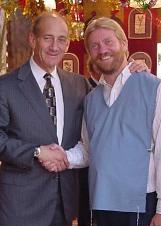
Prime Minister Olmert and
President Bush are pursuing a solution that will not work, because it
goes against what God has already foretold in prophecy. The solution
is simple, yet it requires more faith than either, at this point, are
willing to possess.
Allow the Northern Kingdom
to return.
Government officials,
however, are not the only ones to blame. The religious
leadership also needs to realize that their actions (or inaction) may
be the very thing that is preventing the Messianic Age.
But how, you may ask, can
a people be allowed to return, when we do not even know who they are?
It is not necessary to
know who they are, only to believe that they exist. Just provide a
pathway and they will come. It is like the movie "Field of
Dreams". This, however, is a WORLD of dreams ... a world at peace.
The House of Israel is
bubbling up all around us. It is a closer reality than most
people can possibly imagine. Allow the Northern Kingdom to
return. In the end it will be the only solution.
Rick Richardson
Click Here
to Make Your Comments
Comment:
You’re an unctuous ass, Rick Richardson. And a
digusting liar. You are NOT a practicing Noachide
—you’re an idol-worshipping Christian. You verify
the truth of the Yiddish proverb, “Too much honour
is half disgrace.”
You cannot imagine the emotional damage you have
done to real Noachides like me and who knows how
many others. You should learn to adhere to the
shibboleths of your own religion before you meddle
in the religion of others. As we say up here
to those who have wronged us, “May the rats eat
your mail.”
A real Noachide,
Michael Devolin
Canada
Michael,
This is a bit of a head scratcher, yet I am pleased
to have a post
from a "real Noachide"
Thank you so much,
Rick Richardson
Comments:
I can't find any dates. Is this blog current?
Debbie
Texas
Debbie,
I haven't put up a new post in a while.
Thanks
for reminding me.
Rick
Comment:
You are an censored, Richardson. You are living
in a dream--an illusion. You really need help.
Christian wing-nuts always revert to the ambiguousness
of "prophecy" (and since you're not Jewish, all
prophecy in the Tanach will be outside of your Gentile
realm)  whenever their religious proposals are suspect,
and you are no different.


You are not Jewish, Richardson. You're a Gentile
and an censored. That's all you'll ever be. Stay out of
Israel. Israel doesn't need you. You belong outside of
Israel. You're an idol-worshipping goy. Get real.
Michael
Canada
Michael,
You seem to be upset at something (although I am
unsure
of exactly what). If you have any specific questions, I
would
be more than happy to attempt to answer them.
Thanks
again for your posts.
Rick
Return
and/or Convert
How will the northern kingdom (the lost ten tribes)
return from exile?
From its inception Israel has been an open society. In
that, if you, as a non-Israelite, wanted to become part of the nation
of Israel, you could do so. It has been this way from the time Israel
left the land of Egypt. (Exodus 12:48)
This process, although uncomplicated, was not to be
taken lightly. There were many restrictions and requirements that, as
a non-Israelite, you were not subject to. Circumcision was required
for all males. Both male and female would, in addition, go into a
ritual bath as part of this process. But these physical acts happened
only after it was determined that the individual was truly sincere in
their desire to become an Israelite.
It has long been the practice of the southern kingdom
(Judah) to discourage a Gentile from “converting”; and rightly so.
After all, the Gentile does not become a better person by virtue of
the amount of laws he needs to obey. He is perfectly fine to remain an
uncircumcised “righteous gentile” observing the seven Noahide laws.
A Jew, however, cannot decide to become a “righteous
gentile”. This situation is in some ways very similar to being a
member of the northern kingdom (the lost ten tribes). Although it may
be hard for someone not in this position to understand, we do not have
a choice in who we are, even though we have no proof of our identity.
The process of becoming a member of the spiritual
nation of Israel has not changed throughout history. Unfortunately the
word “conversion” is more associated with abandonment and betrayal
than it is with joy and return. Yet, if members of the northern
kingdom (or lost ten tribes) are to return at any time in the future,
they must certainly go through this process of education ending with
circumcision and the ritual bath.
If indeed the northern kingdom is in the process of
returning, the exact details of all that will be involved will soon
unfold before us. However, the only method of return will be the
process that has been practiced for thousands of years.
Rick Richardson
Click Here
to Make Your Comments
Comment:
Are you saying that the only way for the lost ten
tribes to return is by converting to Judaism?
Debbie
Texas
Debbie,
The northern kingdom has been assimilated into the
Gentile nations. The ONLY way for a Gentile to become part of the
nation of Israel is to go through a process including circumcision.
We call that process today "conversion". There has never been
another way. Will that process have a uniqueness considering
the numbers of people involved? I don't know. We will
need to wait and see.
Rick
Comment:
It took me a while to search on the net,
only your site explain the fully details,
bookmarked and thanks again.
Kris
Berlin
Comment:
I seldom leave comments on blog, but I have been
to this post which was recommend by my friend,
lots of valuable details, thanks again.
pret rachat de credit
Marseille
Forgive Me Father ... for I Have Sinned
One of the most difficult things that
we do in life is to admit that we were wrong. It is going through that
process of realizing that we don't have all the answers and then
realizing we didn't even know the questions we all find rather
humbling.
I must admit, I felt I knew a lot more
of the answers to life when I was younger than I am today.
So, what is all this self-reflection
about?
My son and daughter have both grown up
and moved out of the house. They both are struggling to make their way
in life, making poor choices and not interested in the simple advice
from dad. I don't think there is anything harder than to watch your
child go through difficult times, and realize that there is very
little you can do.
It is not until we realize we DON'T
have all the answers that we finally begin to understand life. This
principle is the same in our religious perspective.
As Christians we feel as if we have the
answers to life that Jewish folks need. We have our answers before we
even understand what the questions are. Our views are all neatly tied
up and put into just the right size box that we can store on our
life's shelf. We move through life making unnecessary mistakes because
we refuse to admit we don't know everything; we don't have all the
answers.
A simple and honest look at history and
at the Bible SHOULD help us see things correctly but we have been
looking through our upside-down lenses for so long we do not
understand how backward we have been.
According to what I see written in
prophecy, it is the northern kingdom that has been lost. I find no
place where the northern kingdom comes back so they can teach the
southern kingdom.
For those who believe that they are
part of the returning Lost Ten Tribes of Israel, it is time to realize
that we (the northern kingdom) are not the ones with the answers. We
are the prodigal son; we are NOT the faithful son. We, however, have
been away for so long that we honestly believe that WE are the ones to
save the day.
Until we reach into our own hearts and
begin to understand how terribly off track we have been, our road back
will continue to be a distant one. Not until we can come before God
and confess, "Forgive me Father, for I have sinned", will we be able
to begin the journey home.
God tells us that the answers are well
within our reach, if only we are willing to see them.
Rick Richardson
Click Here
to Make Your Comments
_______________________________________________________________
Comment:
Thank you very much for encouraging 10-Israel
to come back home. We (me with family), are on the way.
Still we have many questions, that must be answered.
We wait on Him.
Shalom
Sonja
Morschen/Hessen/Deutschland
_______________________________________________________________
Comment:
The more we seek the truth about our Elohim,
the more we realize how little we know. I use to think
we had almost all the answers, as a “Christian”, but
He has humbled us. How arrogant we are. How much
correction is needed! It's funny how the truth of
knowing who we are now (lost Israel) has made us feel
more lost than ever! I can hardly wait till we can
finally go home!
Shari
Burns,OR USA
_______________________________________________________________
Comment:
I have read some of your comments about the return
and restoration of Israel to the Holy Land. I am in agreement
with at least part of what you have said here. Please let me
share some my views with you. The infrastructure of design,
the paradigm of God's plan for mankind is seen in the
covenant that the LORD made with Abraham (father of many
nations) and the later reiterated with his grandson Israel
which consists of three parts; one-the Holy Land, two-"kings
will come" (the promise of the Christ), three-"a nation
and community of nations"; (the worldwide government of
God or Millennial Reign of Jesus Christ). The House of Judah
is the lessor and The House of Joseph is the greater part of
"The Greater Israel". Christ Jesus is the fulfillment of all
the Law and Prophets and everything belongs to him. We
believers are heirs to the promises He made to Israel (greater
Israel and lessor). Gal.3:29 Restoration of Israel means the
Throne of David will completely reunite Ephraim with Judah.
"all Israel will be saved" The House of Judah will continue
to be hardened until the full number of gentiles (the House
of Joseph) come into Israel. Romans 11: 25-27 History has
confirmed that God is sovereign over the events that fit the
pattern of His plan which reflects the perfect infrastructure
of design seen in scripture.
Stephen Richardson
Montgomery,TX
Stephen,
You appear to be looking in some of the right places;
but are coming to the wrong conclusions. May I suggest
you read my book, "Origins of Our Faith" (it is available
to read on line, totally free of charge).  Thank you for your
comment.
Rick
A Sad Day in Israel
Today Israel expelled the people of
Gush Katif from their homes. The following is taken from Shlomo
Wollins website (IsraelReporter.com).
| 9:10 am.
[israelreporter.com editor’s note: I
have reached final stages of packing and will shortly have to pack
my computer equipment. I offer you the following last-minute
coverage from INN of the arrival of the final, deportation troops
entering the beautiful city of Neve Dekalim to escort 100% of its
inhabitants (with or without force) to an unknown destination.
The families here (many with 5-10 kids)
have not been given any notification of immediate or long-term living
arrangements. I will not, however, be offered a new living option or
compensation; not that I would accept anything from this corrupt
government at this point.
My wish is to restart my life anew, and
all I hope for at this point is not to be arrested/detained and be
dropped on the streets of Holy Jerusalem to recover from this horrific
ordeal….I can see soldiers coming up the street…time for me to close
my computer and finish packing…after nearly 100 days reporting live
from Gush Katif…the soldiers are coming to remove me from this place
and the people that I have come to love…from what is now home to
me…from where I was hoping to marry, and build a family and home….from
the most beautiful and splendid expression of Jewish settlement on the
planet…Gush Katif…we will come back one day and make you blossom
again…and once again the sound of Jewish children playing will
return…for now…goodbye Gush Katif…
I’ll miss you and cry for you forever..
Shlomo from a tear-stained keypad
awaiting deportation…]
|
How sad. How very sad.
Rick Richardson
Click Here
to Make Your Comments
Tisha B'Av
Today is the 9th of Av on
the Hebrew Calendar. It is a fast day, (neither food nor drink are
consumed), and a day of mourning. It was on this day that both the
first and second Temples were destroyed. In addition there is a list
of evil events associated with this day.
It is not surprising that
the expulsion of Jews from their homes in Gaza falls also on this day.
What DOES surprise me is the amount of support AMONG THE JEWISH PEOPLE
for such a plan. What can they possibly be thinking?
For the life of me, I
cannot understand why any Jew would believe that what is happening now
in Gaza (and being proposed to happen in Samaria) is a good thing. How
does this in ANY WAY benefit Israel? Yet the final vote in the Knesset
to move forward with this plan was approved 17 to 5, and reports
continue to say that 65% of the Jewish population are IN FAVOR of the
expulsion plan!
Today's actions by the
Israeli government remind me that the string of evil events that have
happened throughout history on the 9th of Av, began with such an act.
When Moses sent 12 spies into the promised land, ten of them came back
with an "evil report". They would not trust in God to fight their
battles and they rejected the promised land. It is no coincidence that
for the majority of its history ten of the 12 tribes have been lost,
not even knowing who they are.
The exile of the northern
kingdom has gone on too long as it is. It is not time to retreat from
the land. It is time to stand before God and trust Him as deliverer.
Rick Richardson
Click Here
to Make Your Comments
The Phenomenon
(originally posted March
2001)
Something is happening. In
every denomination within the Christian Church there is a drawing; a
tug back to the origins of our faith. We who are being drawn are
seeking something, but we are not always sure what that something is.
We are part of a phenomenon, trying, (to the best of our abilities),
to follow that tug, that we believe is God Himself drawing us back to
our beginnings.
From my perspective, it is
not necessarily essential to know why the phenomenon is happening,
only to see that it is. It is somewhat like the movie “Close
Encounters of the Third Kind”. Many people feel like the character
played by Richard Dreyfus. They are pulled toward Jerusalem. They are
compelled to reevaluate, and begin to observe in a more complete way,
the Sabbath and the Biblical Holy Days. Prayer and gratitude and an
eagerness to learn are becoming more prominent in their lives. They
find a kinship with complete strangers who are also being pulled the
same direction, to the same end.
There is no organization
that will control or contain it. It is not our doing, ... it is God’s.
That, however, does not mean that there will not be organizational
attempts to take control and even take credit for the movement now
a-foot. This, in itself, is the biggest obstacle that we are facing;
to allow God to do His work, and for those of us who are leaders to
be gentle guides. To not evaluate our own significance as of any
importance. To not read ourselves into prophecy. To not focus upon our
own accomplishments, as if they were the important factor.
When you get right down to
it. None of us have the market on being able even fully comprehend
what He is doing. Every time I believe I understand the breadth of
what He is doing, I soon realize; I was only seeing the edges of a
small corner.
What then are we to do?
Should we sit back and ignore it, avoiding taking any active roll? No,
but neither should we force it into our individual areas of comfort
and familiarity. We should be aware of and watchful for, those people
eager for followings ... for the person who believe that God has given
His truth to them alone.
As phenomenees and
observers of this phenomenon unfolding, let us not be focused in
narrow areas and subjects that will divide us. Rather let us focus on
what unites us; the topics, issues, and values that we can clearly see
we are all moving toward. Asking each other for patience and
understanding. Being able to teach and be taught. Not forcing or
convincing, but gently guiding, directing, and educating in the
service of one another.
Rick Richardson
Click Here
to Make Your Comments
Comments:
very good ,very good shalom
|